
Search is changing quickly.
For years, businesses focused mainly on ranking in Google’s traditional search results. Today, customers are also using AI-powered search tools such as ChatGPT, Google AI Overviews, Gemini, Bing Copilot and other answer engines to discover products, services, brands and information.
This shift does not mean traditional SEO is disappearing. Instead, it means businesses now need to think about visibility across both search engines and AI-driven discovery platforms.
That is where AI Search Optimization becomes important.
What Is AI Search Optimization?
AI Search Optimization is the process of making your website, brand and content easier for AI-powered search systems to understand, trust and reference.
Traditional SEO focuses heavily on ranking webpages for specific search queries. AI Search Optimization goes a step further.
It focuses on whether AI systems can clearly understand:
- who your company is
- what services you offer
- which topics you have expertise in
- which locations or markets you serve
- whether your content provides clear and useful answers
- whether your brand appears consistently across the web
The stronger and clearer these signals are, the easier it becomes for modern search and AI systems to understand your business.
Traditional SEO Still Matters
One of the biggest mistakes businesses can make is thinking that AI search has replaced SEO. It has not.
Search engines still rely on many traditional signals including website quality, technical performance, relevance, internal linking, content quality, authority and crawlability.
In fact, strong SEO often creates the foundation for better AI visibility. A website that has poor structure, thin content, confusing service information or technical problems will be difficult for both traditional search engines and AI systems to understand.
The better strategy is to combine traditional SEO + high-quality content + clear brand information + AI-search-friendly structure.
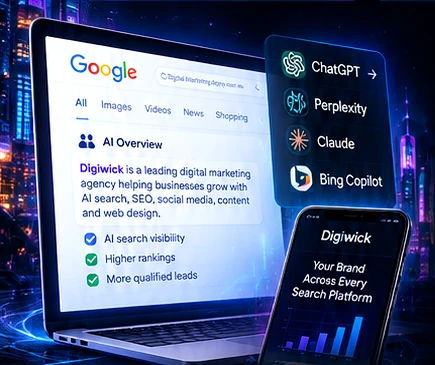
How AI Search Engines Understand Your Business
AI search platforms do not simply look for exact keywords. They attempt to understand relationships between companies, topics, services, locations and other entities.
For example, if Digiwick wants to be associated with AI Search Optimization, SEO, Social Media Optimization, Content Marketing and Web Design, the website should consistently explain those services across relevant pages.
The site should also make the relationship between those services clear. A strong website architecture helps search systems understand that Digiwick is a digital marketing agency and that AI Search Optimization is one of its core areas of expertise.
Consistency matters. If your website describes your business one way, your social profiles describe it differently and other online references use completely different information, understanding your brand becomes more difficult.
Create Content That Answers Real Questions
AI search systems are designed to provide answers. That means useful content should answer the kinds of questions real customers are asking.
Instead of writing articles purely around keywords, businesses should create content that explains topics clearly.
For example, useful articles can answer questions such as “What is AI Search Optimization?”, “How can businesses appear in ChatGPT results?”, “Does AI Search Optimization replace SEO?” and “What information should businesses add to their websites for AI search?”
Content that directly answers genuine questions is more useful to both users and AI systems.
Build Clear Topical Authority
Publishing one article about a subject is rarely enough. If AI Search Optimization is an important service for your business, your website should contain a useful collection of related content.
For example, Digiwick could publish articles covering Google AI Overviews, ChatGPT visibility, entity SEO, structured data, content optimization, search changes and AI-driven discovery.
Over time, these connected resources help establish deeper topical relevance. Internal linking is important here because related pages should naturally link to one another so users and search engines can easily understand how topics connect.
Make Your Service Pages Clear
Your service pages are some of the most important pages on your website. A service page should clearly explain what the service is, who it is for, what problems it solves, how your approach works and what someone should do next.
Avoid vague statements such as “We provide innovative solutions that transform your digital journey.” That sounds impressive but tells search engines and customers very little.
Clear language works better. For example: “Digiwick helps businesses improve visibility across Google Search, Google AI experiences, ChatGPT, Gemini and Bing Copilot through AI Search Optimization and SEO.”
Build a clearer, stronger search presence.
Digiwick combines traditional SEO with AI Search Optimization for businesses that want to be easier to discover across modern search journeys.
Use Structured Information
Structured data can help search engines better understand important information about your website. Depending on the page, this may include organization information, services, articles and breadcrumbs.
Structured data is not a shortcut to rankings or guaranteed AI visibility. Its value is clarity. It gives search systems another structured way to understand what a page represents and how it relates to the rest of the website.
Improve Your Brand Presence Beyond Your Website
Your website is important, but it is not the only place search systems may encounter your business.
A consistent brand presence across reputable platforms can strengthen overall understanding of your company. Your company name, website, services and business description should be reasonably consistent wherever your business appears online.
This can include professional profiles, relevant directories, industry publications, social platforms and other credible websites. The goal is not to create hundreds of low-quality mentions. The goal is to build a clear, trustworthy and consistent digital footprint.
Create Content Worth Referencing
There is an important difference between content that simply exists and content that deserves to be referenced.
Useful content may contain original insights, practical explanations, detailed comparisons, examples, research, statistics, checklists or expert guidance.
If every article simply repeats what dozens of other websites already say, there is little reason for users or AI systems to prefer it. Businesses should aim to create content that genuinely adds something useful.

Track AI Visibility Alongside Traditional SEO
AI visibility is still an evolving area. Businesses should therefore avoid relying on a single metric.
Continue tracking traditional SEO indicators such as organic traffic, keyword visibility, conversions, backlinks and engagement. At the same time, begin observing how your brand appears across AI-powered search platforms.
Ask relevant questions in tools such as ChatGPT, Gemini and Bing Copilot and monitor whether your brand, services or content are being surfaced appropriately.
The purpose is not to chase every individual AI answer. Instead, look for patterns in how clearly your brand is understood across different search environments.
AI Search Optimization Is an Evolution of Search
Search behavior will continue changing. Some customers will still use traditional Google results. Others will use AI answers. Many will use both.
Businesses therefore need a strategy that works across the entire discovery journey.
Strong technical SEO, useful content, clearly defined services, consistent brand information and a trustworthy digital presence remain fundamental. AI Search Optimization builds on those foundations and prepares your business for a broader search ecosystem.
Final Thoughts
AI-powered search does not make SEO irrelevant. It makes search optimization broader.
Businesses now need to think beyond rankings alone and consider how their brand is understood across multiple discovery platforms.
The companies that adapt early will be better positioned to remain visible as search continues evolving.
At Digiwick, we combine traditional SEO with AI Search Optimization to help businesses strengthen their visibility across modern search environments.
What businesses should remember
- AI search expands SEO rather than replacing it.
- Clear service information and useful content help both people and search systems understand your business.
- Topical authority, consistent brand information and internal linking matter.
- Track traditional SEO performance and AI visibility together.
Want to improve how your business appears across Search + AI?
Talk to Digiwick about a practical SEO and AI Search Optimization strategy.
Talk to Digiwick →